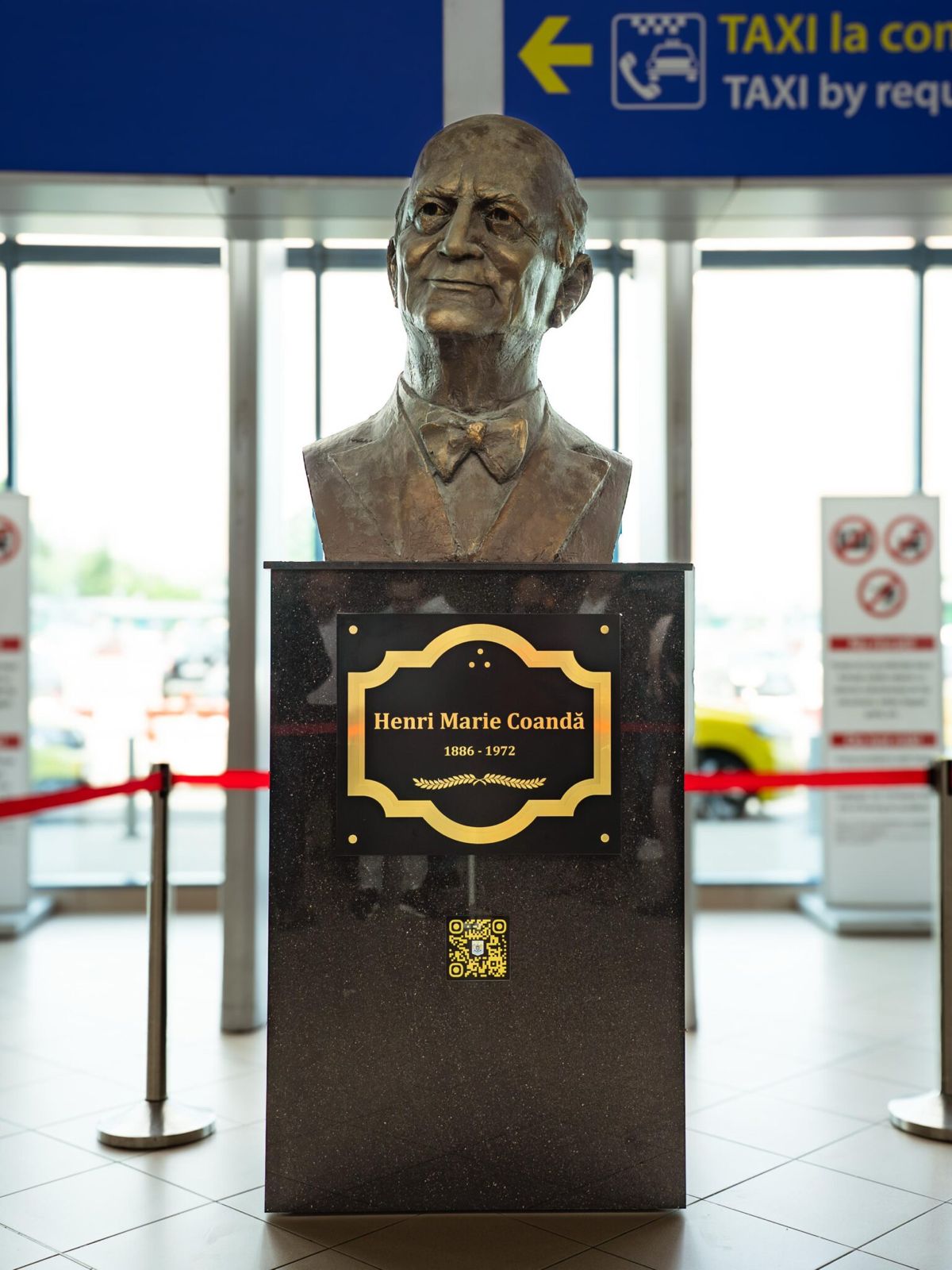
In the spirit of its fundamental mission to promote and honor Romanian cultural heritage, as well as illustrious personalities who, through their substantial contributions to art, culture, science, technology, and research, have decisively marked the history of our country and humanity, the is honored to present an exceptional project: the bust of academician Henri Marie Coandă.
This monumental work is located within the grounds of Henri Coandă International Airport in Bucharest, marking an eternal tribute to his genius.
Henri Marie Coandă: A brilliant mind of the 20th century
Henri Marie Coandă (1886–1972) was one of the most brilliant minds of the 20th century, a scientist, inventor, and aviation pioneer who knew how to combine science with intuition and rigor with a vision of the technological future. Born in Bucharest on June 7, 1886, Coandă stood out early on for his extraordinary curiosity and deep thirst for understanding the laws of nature.
In 1910, at just 24 years old, Henri Coandă presented what many consider to be the world’s first jet aircraft, the “Coandă-1910,” at the Paris Air Show. Even though the aircraft did not complete a full flight, its operating principle profoundly influenced the future of aviation. His most famous discovery, the Coandă effect, describes the tendency of a fluid jet to stick to a curved surface, a phenomenon that is essential in aerodynamics and modern engineering, with vast applications in aviation, medicine, construction, and architecture.
Throughout his life, Henri Coandă patented over 250 inventions and collaborated with research institutes and governments across Europe, innovating in various fields: from devices for detecting liquids in soil to desalinating water using solar energy and high-speed container transport, an idea recently revisited by the Hyperloop project.
Coandă’s life was marked by discretion, but also by depth. He worked in laboratories, collaborated with governments, but always remained attached to the idea of universal knowledge and human progress. In the last decades of his life, he was affiliated with the initiatory and spiritual circles of the time, an aspect which, whether real or symbolic, amplifies the philosophical dimension of his work. In his view, science was not only technical, but also a path to light, knowledge, and harmony.
Henri Marie Coandă died in 1972, but his ideas live on in every modern airplane, in every application of the effect that bears his name, and in every young person who looks up at the sky with a desire to understand it. He was not only an inventor, but a symbol of a creative Romania, connected to great universal values.
A celebration of Romanian excellence
By unveiling the bust of Henri Marie Coandă, the National Grand Lodge of Romania celebrates one of the major figures of our cultural and scientific heritage, conveying to future generations respect for those who have marked the course of Romania and humanity. Through this work and its message, we wish to engrave in the collective memory a truth that must be recognized as the foundation of our identity: national values have shaped us as a people and as individuals and have strengthened our role in intercultural and interstate dialogue at the European and global levels. At the same time, these values convey meaning, determination, motivation, and direction to future generations. They are more than our national symbols; they are defining components of our Romanian soul.
The significance of the sculptural work and artistic vision
Monumental sculpture plays an essential role in educating the public and shaping collective consciousness. And the example of Henri Marie Coandă highlights the importance of critical thinking, tireless research, and the ability to push boundaries. His legacy belongs not only to Romanian culture—as a French citizen, Coandă also illustrates human excellence in a European and global context.
Sculptor Radu Drăgușin’s vision of capturing the noble and wise features of the academician in his portrait, as well as his detached and jovial attitude, characteristic of a brilliant mind, is profound and remarkable. Such a visual representation can communicate to the public not only the biographical facts of Coandă, but also his humanity and spirit, the essence of a mind dedicated to progress and knowledge. Through art, we have the opportunity to perpetuate not only the memory of a scholar, but also the values he embodied: curiosity, innovation, and perseverance. We are convinced that such an artistic approach will enrich the public space and provide a valuable cultural and educational landmark for present and future generations.
Author of the work
The bust of academician Henri Marie Coandă was created by Romanian sculptor Radu Drăgușin, known for his contributions to monumental sculpture. Among his most important works are:
– Bust of Acad. Mircea Malița – Euro-Atlantic Resilience Center, Bucharest (2023)
– Bust of Constantin Brâncuși – Brâncuși Cultural Center, Târgu Jiu (2021)
– Bust of director Alexandru Ducu Darie – Bulandra Theater (2019)
– Bust of Nicolae Titulescu – Alba Iulia (2018)
– Monument to the Heroes who fell in World War I – Bascov, Argeș (2018)
Through this initiative, the National Grand Lodge of Romania reaffirms its commitment to the fundamental values of society and to cultivating the memory of those who, through their thinking and creativity, have brought progress and enlightenment to the history of humanity.