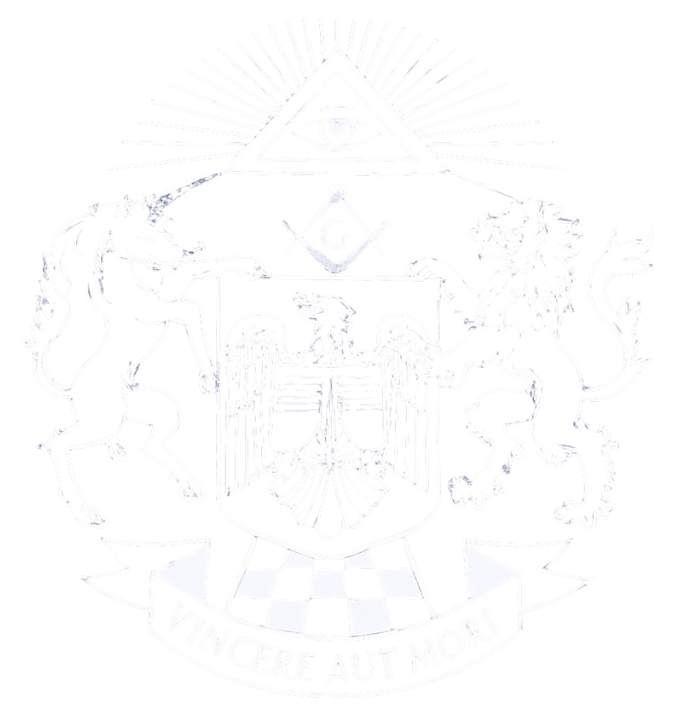
Freemasonry is one of the oldest fraternal societies. The following lines explain how Freemasonry is practiced by the National Grand Lodge of Romania (NGLR), the Grand Lodge that administers all regular Lodges on Romanian territory, and seek to clarify, in good faith, some preconceived ideas about Freemasonry.
Freemasonry cannot be defined in a few sentences. It is often described as an allegorical system of morality, illustrated through symbols. Beyond this dimension, Freemasonry is also an organized institution with clear rules, principles, and customs that have been carefully passed down and preserved over the centuries.
By cultivating responsibility, morality, and truth among its members, Freemasonry encourages Freemasons to apply the lessons learned in allegorical rituals to their daily lives.
The NGLR is a regular Grand Lodge, whose activities are conducted in accordance with the traditional principles and customs of Universal Regular Freemasonry. Internationally, the NGLR is recognized by the United Grand Lodge of England (UGLE) and numerous regular Grand Lodges around the world, based on universally accepted criteria of regularity.
The essential condition for admission into the Order is belief in the Divine—generically referred to as the Great Architect of the Universe—and belief in the immortality of the soul.
The Order is open to men who have reached the age of 21, of any race or religion, of good reputation, and who meet the above-mentioned admission requirements.
Freemasonry is not a religion, nor is it a substitute for religion. It is open to practitioners of any religion, who are completely free to follow their faith unhindered after joining the Order.
At the same time, within Masonic Lodges, members of the Brotherhood are forbidden—under penalty of Masonic irregularity—to debate or engage in disputes on religious matters.
Since its inception, Freemasonry has consistently followed three fundamental principles: brotherly love, mutual aid, and truth.
Brotherly love means tolerance and respect for the opinions of others and conduct characterized by kindness and understanding toward every human being.
Mutual aid is a virtue practiced not only towards family, but also towards the community in which we live, through concrete individual efforts. The fate of orphans, the sick, and the elderly has been a constant concern of the members of the Order since ancient times.
For Freemasons, truth is the touchstone of their training and must prevail in all circumstances.
Freemasons strongly believe that putting these principles into practice is the path to the highest standards of behavior for every human being.
Freemasonry requires each member to strictly observe the laws of the country in which they operate and not to participate in any action that would undermine the sovereignty or welfare of their own people or the country in which they are temporarily residing, with any deviation resulting in expulsion from the Order.
The principles of Freemasonry do not conflict with the civic duties of the members of the Order; on the contrary, the Brotherhood requires each member to loyally fulfill his civic duties.
Freemasonry is not a secret society, insofar as each Regular Grand Lodge is a legally constituted institution, officially recognized and operating in accordance with the laws of each country.
Freemasonry is a discreet society, not a secret one. The only “secrets” are related to rituals and traditional ways of recognizing fellow members. The principles, symbols, customs, and goals of the Order are public; and the fact that some internal matters are not made public is normal for any association that treats its internal affairs with discretion.
The Statutes of the National Grand Lodge of Romania are public, being registered in the National Register of Non-Profit Legal Entities, and the National Grand Lodge of Romania is recognized by the Romanian Government as an Association of Public Utility.
Respecting the political choices of its members, Freemasonry prohibits the debate and adoption of resolutions in Lodges on political issues, with any deviation resulting in irregularity and expulsion from the Order. Likewise, discussions concerning economic interests are not permitted in Lodges.
Universal Regular Freemasonry is practiced by numerous independent Grand Lodges, which adhere to the basic condition for admission to the Order—belief in the Supreme Being and the immortality of the soul—as well as the customs of the Brotherhood known as Landmarks.
However, there are Grand Lodges and other supposedly Masonic bodies that do not require their members to believe in the Supreme Being and allow them to debate and adopt resolutions on political issues in the Lodges. These structures (often called Grand Orient), as well as organizations claiming to be Masonic, are not recognized as regular by the United Grand Lodge of England and, implicitly, by the entire Universal Regular Freemasonry.
A Freemason must, first and foremost, serve his country with devotion and loyalty and fulfill his duty to the Supreme Creator—whatever name he is known by, according to his faith.
It can also be said without hesitation that the above ideas do not belong exclusively to Freemasonry, but can be accepted by people of good faith who care whether or not we will have a better world tomorrow.